

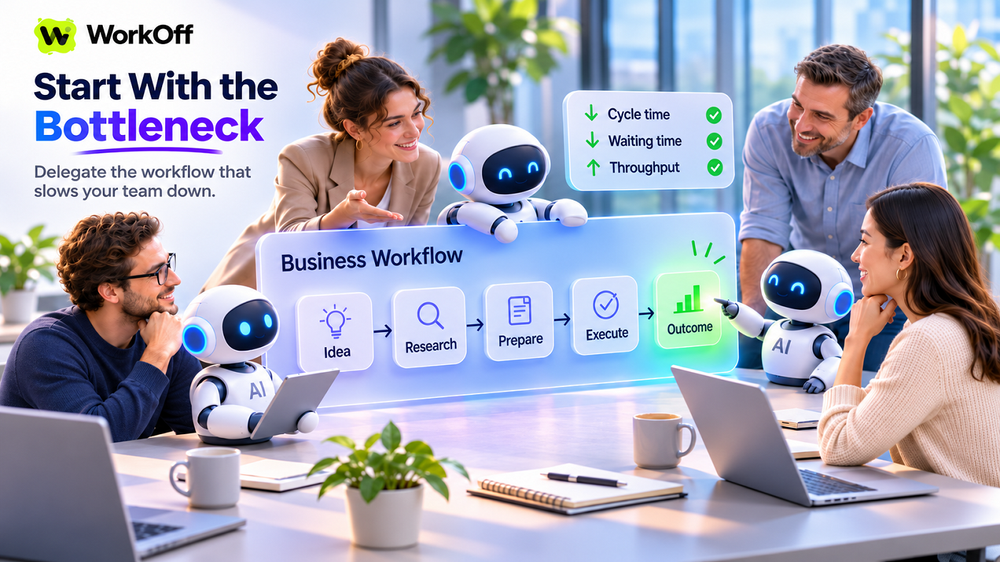
AI adoption often starts with a technology question.
A company sees what AI agents can do and begins asking:
Which agent should we build first?
Should it be a sales agent? A marketing agent? A coding assistant? An AI researcher? A meeting agent?
These are reasonable questions, but they may lead teams in the wrong direction.
The better starting point is not the agent itself.
It is the workflow.
More specifically:
Where is work repeatedly slowing down, waiting for someone, or consuming human time without requiring much human judgment?
That is often where AI agents can create the most value.
Instead of deploying AI because a capability looks impressive, businesses can start by identifying a real operational bottleneck, defining the outcome they want to improve, and then deciding whether an agent should take responsibility for part of that process.
This workflow-first approach is increasingly important as companies move from experimenting with AI assistants toward using AI as part of everyday business operations.
Every company has processes that work, but not efficiently.
A salesperson may spend an hour preparing for a 20-minute conversation.
A marketing team may have plenty of campaign ideas but not enough capacity to research, prepare, publish, and measure them.
An engineering team may write software quickly but wait days for testing or deployment.
A meeting may produce several decisions, yet none of them turn into tasks until someone manually creates them later.
These are not necessarily AI problems.
They are workflow problems.
AI becomes useful when it can remove part of that friction.
This is one reason platforms such as WorkOff are moving toward an AI-native workplace model, where people and AI agents can participate in the same workflows rather than treating AI as a separate chatbot that waits for prompts.
The distinction matters.
An assistant answers.
A useful business agent takes responsibility for a clearly defined part of a process.
One of the easiest ways to find a good AI use case is to look for work that spends too much time waiting.
Consider a typical sales workflow.
A company has a list of potential accounts.
Before an account is ready for outreach, someone may need to:
None of those steps may be especially difficult.
But together they can create a bottleneck.
Sales representatives end up spending valuable time preparing opportunities instead of speaking with prospects.
This is where AI agents for business can become useful.
Instead of asking an AI assistant to research each company manually, a business can define a structured workflow and delegate parts of it.
The result should then be measured against the sales process itself.
Did research time fall?
Did more qualified opportunities reach salespeople?
Did representatives spend more time in conversations?
Did the time from lead identification to outreach decrease?
If the answer is yes, AI is contributing to the workflow.
If the only measurable result is that the AI generated more text, the business may not have improved very much.
Marketing teams face a similar challenge.
Ideas are rarely the main constraint.
Most teams already have more potential campaigns, articles, landing pages, experiments, keywords, and channels than they can realistically execute.
The bottleneck is often everything between the idea and the finished result.
A campaign may require:
research → positioning → content → creative → review → publishing → distribution → measurement
Generative AI can accelerate individual steps.
But the larger opportunity comes from coordinating them.
One agent may perform competitor research.
Another can prepare search or market analysis.
Another can create initial content.
Another may help organize campaign execution.
A coordinated AI Team can move work between these stages while humans remain responsible for strategy, judgment, brand decisions, and final approval.
Again, the important measurement is not how much content AI produces.
It is whether the marketing process becomes more efficient.
For example:
Did the average time from campaign idea to launch fall from ten days to six?
Can the same team complete more experiments each month?
Are fewer campaigns delayed because research or preparation is incomplete?
Those are operational improvements.
Engineering provides another important example.
AI coding tools can reduce the time required to implement software.
But implementation is only one stage of software delivery.
A feature may also require:
If AI dramatically speeds up coding but testing remains unchanged, the bottleneck simply moves.
Now developers produce more code while QA becomes overloaded.
The same can happen with deployment.
Giving an AI agent the ability to run deployment commands may reduce manual effort, but it does not automatically make the delivery process safer or faster.
Businesses need to ask which part of the workflow is actually constrained.
Perhaps the right AI use case is not coding.
It may be preparing tests, reviewing a release candidate, identifying deployment risks, collecting verification evidence, or coordinating the handoff between engineering and operations.
The goal should be shorter, more reliable delivery cycles - not simply more generated code.
Meetings are another area where the difference between activity and outcome becomes obvious.
A productive call may end with three important decisions.
For example:
But after the call, no tasks are created.
No owners are assigned.
No deadlines are recorded.
The meeting was useful, yet execution stops.
This is a classic workflow bottleneck.
An AI agent can potentially capture decisions, identify required actions, prepare tasks, organize context, and help move the work into the systems the team already uses.
The real value is not a better transcript.
It is a shorter distance between:
decision → action
This distinction is important across almost every business process.
AI should not simply document work.
Where appropriate, it should help move work forward.
Not every process should be delegated.
A useful starting workflow usually has several characteristics.
A process that occurs every day or every week is easier to evaluate and improve.
Recurring workflows also make the return on automation easier to measure.
An agent performs better when the organization can define what a successful result looks like.
“Help our sales team” is vague.
“Research these companies, verify them against our ICP, identify decision-makers, and return supporting evidence” is much clearer.
AI is particularly useful when a workflow contains repeatable stages, known inputs, and observable outputs.
The more ambiguous the work becomes, the more important human judgment is.
Businesses should be able to inspect what an agent has done before consequential actions occur.
This is especially important during the early stages of AI adoption.
An agent should not automatically have unlimited access simply because it can perform a task.
Teams should define:
This turns autonomy into controlled delegation.
One of the most important changes businesses can make is to stop measuring AI primarily by AI-specific metrics.
The number of prompts does not tell you whether the company is becoming more effective.
Neither does the number of generated documents.
Instead, measure the process.
Useful metrics may include:
Cycle time
How long does the workflow take from beginning to end?
Waiting time
How much time does work spend waiting for the next person or stage?
Throughput
How many completed outcomes can the team deliver during a given period?
Rework
How often does work need to be corrected or repeated?
Handoffs
How many transitions between people, systems, or teams are required?
Imagine that a team previously completed 20 qualified account research packages per week.
After delegating part of the workflow to AI, it completes 45 without increasing headcount.
At the same time, average waiting time falls from one day to two hours.
That is a measurable improvement.
The business does not need to ask whether the agent looked intelligent.
The workflow itself provides the answer.
There is also an important warning.
If a team cannot explain how a process works, adding AI may not fix it.
It may simply execute an unclear process faster.
Before delegating a workflow, teams should understand:
AI can scale a clear process.
It can also scale confusion.
In many cases, defining the workflow is therefore the first step toward useful AI adoption.
Another decision is whether a workflow needs one agent or several.
The answer should depend on the work.
A single agent may be enough to research a company or summarize a document.
More complex processes may benefit from specialization.
For example:
Research agent → Analysis agent → Execution agent → Review agent
Each agent has a different responsibility.
The benefit is not simply having more AI.
It is separation of roles.
A research agent gathers evidence.
An execution agent acts on the resulting plan.
A review agent checks the result.
This can create useful checks and balances.
However, adding multiple agents to a simple task can create unnecessary coordination overhead.
A good rule is:
Use the simplest architecture that can reliably complete the workflow.
Businesses do not need to redesign every operation around AI immediately.
A much safer approach is to choose one bottleneck.
Define one workflow.
Give AI one bounded responsibility.
Then measure what happens.
Suppose sales research is the bottleneck.
Start there.
If the workflow becomes reliable, expand the agent's responsibility or introduce another specialized agent.
Over time, workflows can become connected.
Research can feed sales.
Market analysis can feed marketing.
Engineering can hand work to QA.
Meeting decisions can become operational tasks.
This is where AI begins moving from an isolated productivity tool into part of the company's operating model.
The business conversation around AI is evolving.
Initially, companies asked:
What can AI generate?
Then:
What can AI automate?
The more useful question now is:
Which business outcome can we safely give AI responsibility for?
That question changes the focus from technology to operations.
It forces a company to think about outcomes, ownership, permissions, review, risk, and measurement.
And that is where practical AI adoption really begins.
Before building another AI agent, look at how work moves through your organization.
Where does it wait?
Where does it repeatedly require manual preparation?
Where do handoffs create delays?
Where does a decision fail to become an action?
Find that bottleneck first.
Then decide whether AI can help remove it.
Because the best AI agent is not necessarily the one with the most capabilities.
It is the one that helps your team get more meaningful work done.