

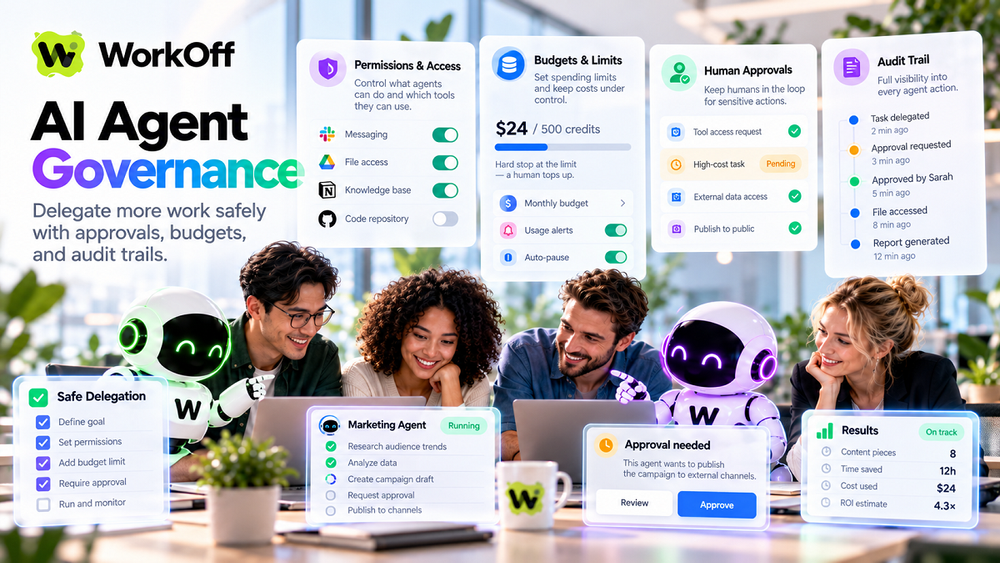
Artificial intelligence is moving from generating answers to taking actions.
That change creates enormous opportunities for businesses.
AI agents can research markets, analyze information, prepare campaigns, work with business tools, coordinate tasks, assist developers, support sales teams, and handle increasingly complex workflows.
But the moment AI moves from “suggesting” to “doing,” a new question becomes critical:
How much authority should an AI agent actually have?
Giving AI access to real business systems is very different from asking a chatbot to write an email.
An agent may interact with files, databases, communication tools, customer information, code repositories, calendars, or external services.
That means businesses need more than intelligent AI.
They need governance.
And AI agent governance may become one of the most important foundations of the next generation of workplace software.
AI agent governance is the system of rules, permissions, controls, and oversight that determines what an AI agent is allowed to do.
It answers practical questions such as:
These questions become increasingly important as organizations move from AI assistants to AI agents that participate directly in business workflows.
Platforms such as WorkOff are being built around this model - allowing humans and AI agents to work in the same environment while keeping agent activity controlled, visible, and accountable.
Consider two simple examples.
A chatbot writes a suggested customer email.
An AI agent sends that email.
The underlying language model may be similar.
But from a business perspective, these actions are completely different.
The first creates information.
The second creates an external consequence.
The same distinction appears across many business processes.
An AI assistant can suggest changes to a database.
An AI agent may be able to make those changes.
An AI assistant can generate code.
An AI agent may be able to open a pull request, run tests, or interact with development systems.
An AI assistant can recommend a campaign.
An AI agent may be able to create assets, update tasks, or communicate with other tools.
As AI gains authority, governance becomes essential.
A common assumption is that the best AI agent is the most autonomous one.
For business use, that is not necessarily true.
The real goal should be useful autonomy.
An AI agent should be able to complete enough work to create meaningful value, while important decisions remain under appropriate human control.
Different tasks require different levels of autonomy.
Researching public information may be safe to run automatically.
Preparing an internal report may require little oversight.
Publishing a message to thousands of customers is different.
Spending company money is different.
Deleting production data is different.
The appropriate level of autonomy depends on the potential consequence of the action.
Good governance allows businesses to make those distinctions.
AI agents become much more powerful when they can use tools.
Those tools may include:
But access should not automatically mean unlimited access.
A marketing agent may need access to research tools and content systems.
It probably does not need access to production infrastructure.
A sales research agent may need company information and prospecting tools.
It may not need permission to delete CRM records.
An engineering agent may need access to a repository while still being restricted from deploying directly to production.
This is why tool allowlists and explicit permissions are important.
The question should not be:
“What can this AI technically access?”
It should be:
“What does this agent need to access to perform its role?”
Human organizations already use role-based access.
Employees receive permissions based on their responsibilities.
AI agents can follow a similar model.
A Research Agent can have one set of tools.
A Content Agent can have another.
A Developer Agent can have another.
A Lead Agent may have the ability to coordinate work while still being restricted from sensitive actions.
This structure becomes especially valuable when organizations begin using multiple agents.
Instead of giving one general-purpose AI system broad access to everything, businesses can create specialized agents with clearly defined responsibilities.
That creates a more understandable operating model.
AI agents do not only create operational risk.
They also create economic activity.
An agent may consume:
Without controls, a badly designed workflow could continue consuming resources far longer than expected.
Budgets provide another governance layer.
An organization can define how much an agent or workflow is allowed to spend before stopping.
This changes the economics of AI deployment.
Instead of discovering unexpected usage after the fact, teams can establish limits before execution begins.
A budget becomes part of the agent's operating boundary.
Human-in-the-loop systems are sometimes presented as a temporary compromise until AI becomes more capable.
That view misses an important point.
For many business processes, human approval is not a weakness.
It is a governance mechanism.
Consider an AI sales agent.
It may be allowed to:
But sending the message may require approval.
A marketing agent may:
Publishing externally may require approval.
An engineering agent may:
Deployment may require approval.
This model allows AI to perform most of the repetitive work while keeping consequential actions under human authority.
The key is not simply adding approvals everywhere.
Too many approvals can eliminate the value of automation.
Too few can create unnecessary risk.
The best approach is to identify decision boundaries.
Low-risk steps can proceed automatically.
Higher-risk steps pause.
The human receives enough context to make a decision.
Then the workflow continues.
This creates a practical balance between speed and control.
A well-designed approval system should answer:
That makes human oversight much more useful than simply asking someone to click “Approve.”
When human employees perform important actions, companies often maintain records.
AI agents should be no different.
If an agent changes something, communicates externally, uses a tool, or completes a workflow, organizations need visibility into what happened.
An audit trail can help answer:
This becomes increasingly important as agents perform more work.
Without traceability, organizations may struggle to understand why something happened.
With traceability, AI activity becomes reviewable.
That is a major step toward making AI agents suitable for serious business environments.
Another useful governance mechanism is isolation.
An AI agent performing code execution, data processing, or tool-based tasks should not automatically operate with unrestricted access to the broader environment.
Isolated execution environments can limit the potential impact of mistakes.
The principle is similar to sandboxing used elsewhere in computing.
The agent receives the resources required for the task without receiving unnecessary access to everything around it.
This becomes particularly important for technical workflows where AI may:
More capable agents make isolation more valuable, not less.
Governance becomes even more interesting when multiple AI agents work together.
Imagine an AI marketing team.
A Lead Agent receives a goal.
A Research Agent studies competitors.
A Content Agent develops messaging.
An SEO/GEO Agent analyzes visibility opportunities.
A Campaign Agent prepares distribution.
The agents may exchange information and coordinate tasks.
This creates additional governance questions:
The architecture of an AI team therefore matters just as much as the intelligence of the individual agents.
Consider an AI-powered outbound workflow.
A business might want AI to:
Much of this can be delegated safely.
But the organization may still want human control over certain actions.
For example:
Research can happen automatically.
Drafting can happen automatically.
Sending an external message may require approval.
Updating CRM data may be permitted within specific fields.
Deleting records may be prohibited entirely.
This is what governance looks like in practice.
It is not an abstract policy document.
It is built directly into the workflow.
Software engineering provides another clear example.
An AI engineering agent may be able to:
But access to production systems may be restricted.
A code review may happen automatically.
Deployment may require a human.
The goal is to allow AI to contribute meaningful execution capacity without giving every agent unrestricted authority.
This same principle can be applied across sales, marketing, operations, finance, customer support, and other business functions.
It may seem that adding permissions and approvals makes AI slower.
In reality, governance can make organizations more comfortable delegating more work.
If a company knows that an agent:
then the company can allow the agent to operate more independently inside those boundaries.
Control creates confidence.
Confidence enables delegation.
Delegation creates leverage.
This is why governance should not be viewed as something that restricts AI.
It can be the infrastructure that allows businesses to use AI more aggressively.
Traditional business software was designed primarily around human users.
Permissions were assigned to employees.
Actions were tied to user accounts.
Approval systems assumed a person initiated the workflow.
AI agents change those assumptions.
Future workplace platforms may need to treat AI agents as first-class operational participants.
That means supporting:
WorkOff's approach to AI agent governance and security reflects this shift by combining agent execution with controls designed to keep humans informed and in control.
AI models will continue becoming more capable.
That makes one question less interesting over time:
Can AI perform this task?
For many workflows, the answer will increasingly be yes.
The more important questions will be:
Should the AI be allowed to perform it automatically?
Under what conditions?
Using which tools?
With what budget?
Who approves the final action?
How can the result be reviewed?
These are governance questions.
And businesses that answer them well will be able to delegate more work without losing control.
Many companies are currently experimenting with AI.
Employees use chatbots.
Teams test automation.
Developers try coding assistants.
Marketers generate content.
The next stage is operational.
AI becomes part of repeatable business processes.
Agents receive responsibilities.
Specialist agents collaborate.
Tools become connected.
Workflows continue without constant prompting.
At that point, governance stops being optional.
It becomes part of the infrastructure.
Organizations do not need to automate entire departments immediately.
A better approach is to start with one controlled workflow.
Choose something that is:
Define:
Then measure the outcome.
How much work was completed?
How much human intervention was required?
Where did the agent need help?
Which controls were useful?
That creates a much stronger foundation for scaling AI across the organization.
The future of AI at work does not have to be a choice between manual processes and fully autonomous systems.
There is a large and useful space between those extremes.
AI agents can handle more research.
More preparation.
More execution.
More coordination.
Humans can retain control over the decisions that matter.
The companies that learn how to design that relationship effectively may be able to scale execution without sacrificing visibility or accountability.
For teams interested in experimenting with governed AI agents and mixed human-AI workflows, WorkOff Early Access provides a way to explore the model in practice.
The future of AI at work may not be about giving machines unlimited autonomy.
It may be about giving them exactly as much autonomy as the business is ready to trust.