

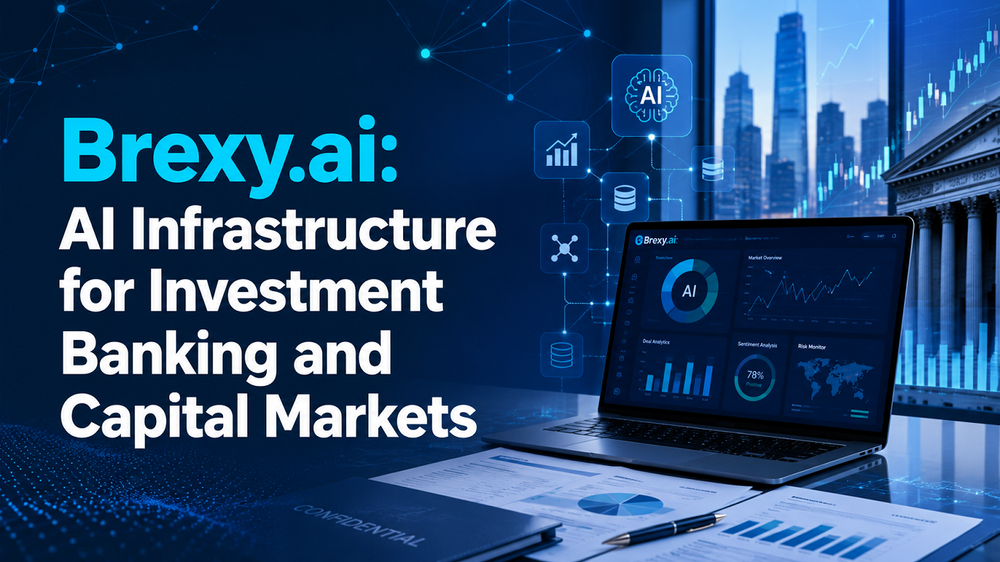
Artificial intelligence has already changed the way professionals search for information, analyze documents, and create content. But in investment banking and capital markets, the real opportunity goes much further.
Financial teams do not need another chatbot that can summarize a document. They need technology that understands how transactions move, how research connects to execution, and how hundreds of individual tasks come together across a live mandate.
This is the environment in which Brexy.ai is positioning itself: not simply as an AI assistant, but as a financial AI platform designed specifically for bankers, investors, advisors, asset managers, and dealmakers.
A typical financial transaction involves far more than asking questions about a company.
Teams may need to analyze hundreds of documents, compare financial performance, identify relevant investors, prepare investment materials, review diligence information, coordinate data rooms, manage NDAs, update pipelines, and keep senior decision-makers informed.
Each task may be manageable on its own.
The challenge comes from connecting all of them.
Generic AI tools can help with individual steps, but financial institutions increasingly need systems that understand the broader context surrounding a transaction.
That is where a purpose-built Financial AI Platform becomes especially relevant.
Brexy is designed around financial workflows rather than adapting a general-purpose AI product to finance after the fact. The platform combines research, execution, automation, and institutional knowledge within one environment.
Research remains one of the most important and time-consuming activities in investment banking and asset management.
Professionals regularly work with company filings, investor presentations, financial statements, market reports, transcripts, diligence documents, internal research, and proprietary data.
The issue is not access.
It is processing all of that information quickly enough to support better decisions.
Brexy's AI Financial Research capabilities are built to work across large document collections, identify relevant information, pull comparables, and support the creation of deal materials with traceable sources.
Instead of spending hours manually searching documents, analysts can dedicate more time to interpretation:
What does this information mean?
How does the company compare with its peers?
Which risks deserve additional attention?
How could the findings affect the transaction?
AI becomes valuable not because it removes analysis, but because it allows professionals to reach the analytical stage faster.
Research is only useful when it leads to action.
For a deal team, the next step may involve identifying potential investors, screening companies, sourcing opportunities, matching counterparties, preparing a memo, or advancing a transaction through the pipeline.
This is where Brexy expands beyond research.
Its AI Deal Execution capabilities are designed to support activities such as sourcing, investor matching, SPAC matching, outbound workflows, and preparation of transaction materials while keeping banker approval within the process.
This reflects an important change in financial AI.
The technology is moving from answering questions to executing structured workflows.
Instead of asking AI to complete one isolated task, teams can increasingly use it across several connected stages of a transaction.
Not every bottleneck in investment banking is analytical.
A significant amount of time is spent managing operational processes surrounding transactions.
NDAs need to be organized.
Engagement letters need to be tracked.
Documents move through data rooms.
Signatures need to be collected.
Pipelines require updates.
Referral relationships and invoicing create additional administrative work.
Individually, these tasks may seem minor. Across multiple active mandates, however, they create considerable operational overhead.
Brexy addresses this through Deal Workflow Automation, connecting processes such as pipelines, NDAs, engagement letters, DocuSign, data rooms, referrals, and invoicing.
For financial teams, this means AI can contribute not only to analytical productivity but also to the operational efficiency of the entire organization.
One of the most important differences between consumer AI and enterprise financial AI is what happens at the end of the process.
A banker does not ultimately need a chatbot response.
The team may need an investment memo.
A financial model.
Diligence materials.
A screening brief.
A pitch deck.
Or a presentation that senior professionals can use in a meeting.
Brexy emphasizes institutional-grade outputs, including auditable financial models, investment memos, diligence materials, and board-ready presentations.
That distinction matters.
AI creates significantly more value when its output can move directly into a professional workflow rather than requiring extensive manual reconstruction.
Most financial institutions already rely on a sophisticated collection of technology platforms.
The challenge is that valuable information may be fragmented between market-data providers, internal databases, CRM systems, document repositories, collaboration software, and data rooms.
Brexy is designed to connect with this existing ecosystem.
The platform lists more than 30 integrations across financial and enterprise sources, including FactSet, LSEG Refinitiv, PitchBook, Preqin, Microsoft 365, Datasite, SEC filings, Bloomberg, Capital IQ, Salesforce, Google Drive, and firms' own data.
This can help create a unified intelligence layer across information that might otherwise remain separated between systems.
A Brexy AI Deal Partner can therefore work with the context surrounding a transaction instead of treating every request as an isolated prompt.
There is another problem AI can help solve: financial organizations continuously create valuable knowledge, but much of it becomes difficult to access over time.
A completed mandate may contain useful company research, investor intelligence, valuation assumptions, diligence findings, and market insights.
Months later, another team may need exactly that information.
Without connected systems, previous knowledge can remain hidden inside old folders, presentations, spreadsheets, and emails.
Brexy's approach to shared deal workspaces and institutional memory creates an opportunity for knowledge to accumulate across the organization.
Research performed for one transaction can provide context for another.
Insights can become organizational assets rather than temporary outputs.
Analysts and senior professionals can work with a more consistent view of active mandates and previous work.
For financial institutions, this may become one of the most important long-term benefits of AI adoption.
Investment banking and capital markets will remain industries driven by human expertise.
AI cannot replace relationships with clients.
It cannot take responsibility for strategic decisions.
It cannot substitute for years of experience in evaluating complex transactions or navigating negotiations.
But it can change how professionals spend their time.
The less time analysts and bankers spend searching for information, transferring data between systems, preparing repetitive materials, and coordinating administrative tasks, the more time they can dedicate to analysis, strategy, clients, and execution.
That is where specialized financial AI can create meaningful competitive value.
The next phase of AI adoption in finance is unlikely to be defined by who has access to the most chatbots.
It will be defined by how effectively financial institutions integrate AI into real workflows.
Research needs to connect to analysis.
Analysis needs to connect to execution.
Execution needs to connect to operational processes.
And every completed transaction should contribute knowledge that improves future work.
Brexy is building around this model by combining AI Financial Research, Deal Execution, Workflow Automation, financial-data integrations, and institutional intelligence within a platform designed specifically for professional finance.
For banks, asset managers, advisors, investors, and dealmakers, the opportunity is not simply to make individual tasks faster.
It is to create a more intelligent way of working across the entire deal lifecycle.
That is the broader vision behind Brexy.ai - turning artificial intelligence from a standalone productivity tool into infrastructure for modern capital markets.