

For years, the standard way to use artificial intelligence at work has been simple:
That model has made AI accessible to millions of people. But it also has one important limitation: AI often remains outside the real workflow.
The next phase of workplace AI is beginning to look different.
Instead of treating artificial intelligence as a separate assistant, companies are starting to explore AI agents that can participate directly in everyday work - receiving assignments, accessing approved tools, collaborating with people, and working toward defined outcomes.
This shift is creating a new concept:
Mixed teams of humans and AI agents.
A traditional AI assistant is primarily reactive.
A person asks a question. The AI responds.
An AI agent can take on broader responsibility.
Instead of asking:
“Can you research these companies?”
a team may increasingly say:
“Research these companies, identify the most relevant decision-makers, summarize the findings, and prepare the next step for review.”
The difference may sound small, but operationally it is significant.
The first interaction produces information.
The second delegates work.
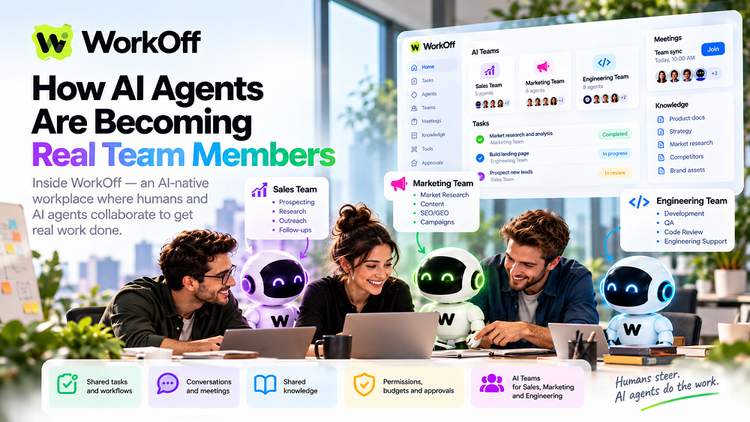
Platforms such as WorkOff are being developed around this idea - giving people and AI agents a shared environment where they can communicate, manage tasks, work with knowledge, use tools, and participate in the same workflows.
Many companies already use several AI products.
One tool generates text.
Another summarizes meetings.
Another researches prospects.
Another helps with code.
The problem is that these tools often operate independently.
As a result:
A shared AI workspace approaches the problem differently.
Instead of putting AI beside the organization, it puts AI inside the workflow.
A task can potentially be assigned to:
Conversations, files, project knowledge, meetings, and work status can remain visible inside the same environment.
This creates an important benefit:
Visibility.
People can see what is being worked on, who - or what - is responsible for it, and where human input is required.
Another important development in agentic AI is the move away from one general-purpose assistant toward groups of specialized agents.
Human organizations already work this way.
A sales team does not expect one employee to handle research, prospecting, account strategy, outreach, and every follow-up equally well.
Marketing teams divide responsibilities between:
Engineering teams include:
AI teams can follow a similar model.
A lead agent can receive a larger objective, divide it into smaller pieces of work, delegate those pieces to specialist agents, and review the combined result.
WorkOff currently applies this concept across areas such as Sales, Digital Marketing, and Engineering.
Instead of relying on one bot to handle everything, an AI Team can consist of several specialist agents coordinated around a shared goal.
Consider a typical outbound sales workflow.
Someone needs to:
A conventional AI tool may help with individual parts of this process.
An agent-based workflow can connect those parts together.
For example:
Identifies companies matching the target customer profile.
Analyzes companies, industries, products, and decision-makers.
Prepares personalized communication based on the available research.
Coordinates the process, checks the results, and prepares the next step for human review.
This is much closer to delegating a business process than simply generating a single AI response.
The same principle can be applied to marketing, engineering, operations, research, and other knowledge-intensive functions.
Marketing is another area where coordinated AI agents can be useful.
A marketing workflow may involve:
Instead of assigning all of these activities to one generic chatbot, different agents can specialize in different parts of the process.
A lead agent can then coordinate their work around a broader objective.
For example:
“Research this market and prepare a campaign strategy.”
That request may involve several agents working on research, competitors, content, SEO, and campaign planning before returning a combined result.
Software development also naturally involves specialized roles.
An AI engineering workflow can include:
Rather than using one AI assistant independently, a coordinated engineering team can distribute different responsibilities across specialist agents.
This makes the concept of AI teams much closer to the structure of a real organization.
As AI agents become capable of doing more, another question becomes increasingly important:
What should an AI agent actually be allowed to do?
Giving an agent access to company tools, data, external services, or budgets creates clear governance requirements.
Useful autonomy needs boundaries.
Those boundaries can include:
The goal is not to remove people from the process.
The goal is to determine which work AI can perform independently and where human judgment should remain mandatory.
This distinction becomes increasingly important as AI moves from generating text to taking real actions.
Imagine an AI agent preparing a report.
That may require very little human intervention.
Now imagine the same agent attempting to:
Those actions have very different levels of risk.
A practical AI workplace therefore needs more than powerful models.
It also needs:
Permissions. Controls. Approvals. Accountability.
This is one of the ideas behind WorkOff.
The platform combines agent workflows with controls such as budgets, permissions, approvals, and activity tracking so that people remain involved when important decisions need human judgment.
Meetings are another interesting part of this transition.
Most current AI meeting products focus on what happens after the meeting:
Agent-based systems can potentially go further.
An AI teammate can become part of the workflow surrounding the meeting.
It may be able to:
This connects communication with execution.
Instead of creating a summary that someone later has to act on, an AI agent can potentially help continue the work that was discussed.
For anyone interested in seeing how this broader workspace model is being approached, WorkOff can be explored here:
Another limitation of isolated chatbot sessions is context.
A chatbot may understand the current conversation, but real work depends on much more than one prompt.
Teams work with:
AI agents become more useful when they can work with the correct context while respecting appropriate boundaries.
A shared workspace allows knowledge to become part of the agent workflow rather than something that employees repeatedly copy into prompts.
Much of the AI market has focused on making conversations with machines better.
Better models.
Better prompts.
Better answers.
Those improvements will continue.
But workplace adoption may increasingly depend on another question:
Can AI reliably participate in the process of getting work done?
That requires more than intelligence.
It requires:
And it requires a clear relationship between human decision-making and machine execution.
This is why the concept of an AI-native workplace is worth watching.
The interesting question is no longer simply whether AI can produce good answers.
The more important question is whether humans and AI agents can work together effectively inside the same operational environment.
The difference between traditional AI assistants and AI agents can be summarized simply.
User asks a question.
AI generates an answer.
User takes the result and continues working.
User defines an objective.
AI receives responsibility for a task.
The agent uses approved tools and available context.
Other specialist agents may participate.
The work progresses.
A human reviews or approves important actions.
The result becomes part of the ongoing workflow.
This is a fundamental change in how companies may interact with artificial intelligence.
The future workplace probably will not consist entirely of autonomous AI systems.
It is also unlikely to look exactly like today's organizations with a few chatbots added on top.
A more realistic direction may be somewhere in between.
The most useful AI may not be the AI that talks the most.
It may be the AI that:
This is a much bigger shift than simply adding another chatbot to the company software stack.
It suggests a new category of workplace software where humans and AI agents operate inside the same environment.
A workspace may include:
Instead of AI being a separate destination, it becomes part of how work moves through the organization.
The next generation of workplace AI is not only about generating better answers.
It is about turning AI into something that can participate in real work.
Humans define the goals.
Humans make critical decisions.
Humans remain in control.
AI agents help research, coordinate, execute, and move work forward.
And the workspace connects everything together.
That is the direction platforms like WorkOff are exploring - and it may become one of the most important changes in how teams use artificial intelligence in the years ahead.